History
Craig Johnston: The Liverpool Midfielder Who Invented the adidas Predator
Every Predator ever made — the Accelerator, the Mania, the Precision, every boot Beckham and Zidane ever wore — traces back to one wet afternoon, one table tennis bat, and one man who would not take no for an answer.
His name is Craig Johnston. Before he changed football boots, he had already done something just as unlikely: he made himself into a Liverpool footballer.
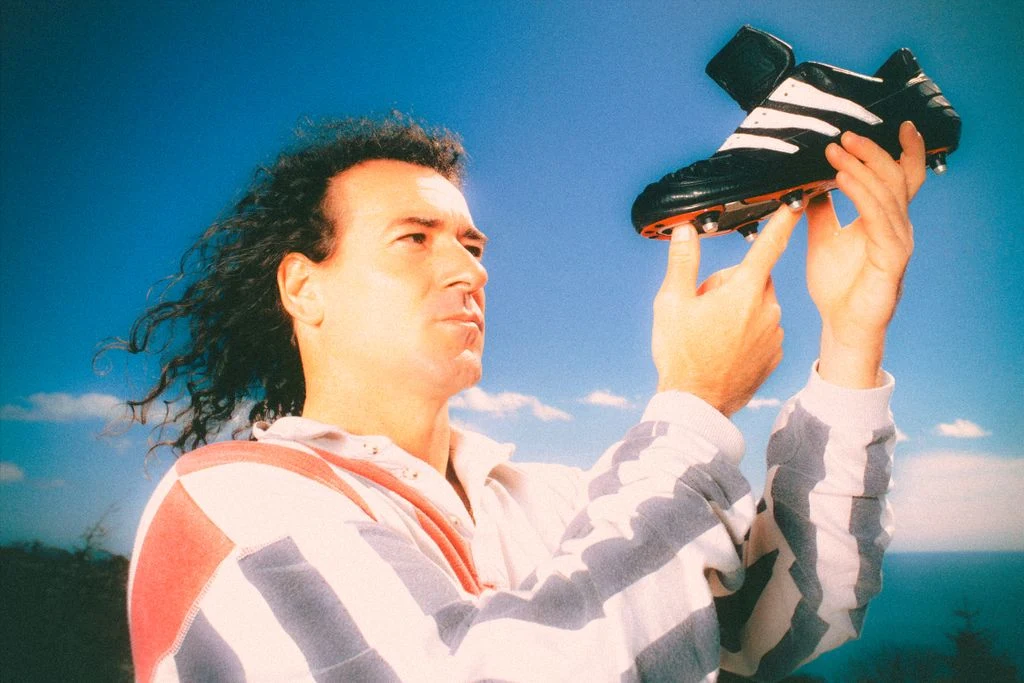 Craig Johnston with the boot his idea became.
The Boy Nobody Rated
Craig Johnston was born in Johannesburg in 1960 and grew up in Australia, in the Newcastle area of New South Wales.
His football career very nearly ended before it began. As a young boy he developed a serious bone disease in his leg, and doctors recommended amputation. A specialist saved the leg. At 14, the problem returned, and he was told to give up football altogether.
He didn’t. At 15, he wrote to a string of English clubs asking for a trial. Only one replied: Middlesbrough. His father lent him the air fare, and he flew to the other side of the world.
The Middlesbrough manager was Jack Charlton, a World Cup winner who did not hand out compliments. After Johnston’s first trial game, Charlton told him to go home. Johnston stayed anyway, training on his own and forcing his way into the club. He made his first-team debut as a teenager and went on to play more than 60 league games for Middlesbrough.
It set the pattern for the rest of his life. Told no, he kept going.
Skippy at Anfield
In 1981 Liverpool signed him. For the next seven years he was part of one of the greatest club sides English football has produced.
Johnston was never the most elegant player in that team, and he knew it. What he had was energy. He ran, and ran, and ran, and the Anfield crowd loved him for it. They called him “Skippy”, after the kangaroo from the Australian TV series.
He made 271 appearances for Liverpool and scored 40 goals. He won five league titles, the FA Cup, two League Cups and the 1984 European Cup. In the 1986 FA Cup final against Everton, he scored Liverpool’s second goal in a 3-1 win, sealing the club’s first league and cup double — and becoming the first Australian to score in an FA Cup final.
He even co-wrote the “Anfield Rap”, Liverpool’s 1988 FA Cup final song, which reached number three in the UK charts.
Walking Away at 27
In December 1987, Johnston’s younger sister Faye was badly injured in a gas leak caused by a faulty heater in her hotel room in Morocco. He flew straight to her, brought her back to England, and arranged for his parents to come over from Australia.
Faye survived, but she needed long-term care. In May 1988, days before the FA Cup final, Johnston told Kenny Dalglish he was retiring. He was 27, at a club that had just won the league. He went home to Australia to be with his family.
It is one of the more remarkable decisions in modern football. It also, indirectly, gave the world the Predator.
The Afternoon It Rained
Back in Australia, Johnston was coaching a group of children. He was teaching them to swerve the ball — to put spin on it the way a table tennis player does, angling the bat across the ball.
One of the children pointed out the obvious problem. A table tennis bat has rubber on it. A football boot is made of leather.
That was enough. The session was rained off, and Johnston went home, stripped the rubber from a table tennis bat, and fastened it around his boot with elastic bands. Then he went back out into the rain and kicked a ball.
By his own telling, the ball squealed like a pig. The rubber gripped it. The ball swerved. Wet leather — the curse of every footballer of his era — suddenly didn’t matter.
Rejected by Everyone
What followed took years and cost him dearly. Johnston has said he built around a thousand prototypes, refining how the rubber ridges should be shaped and where they should sit on the boot.
Then he took the idea to the sportswear companies. adidas said no. So did Nike, Puma, Reebok and Umbro. The consensus was simple: it would never work.
Snow in Munich
In December 1990, Johnston turned up at Bayern Munich and asked to see Franz Beckenbauer — the “Kaiser”, who months earlier had led West Germany to the World Cup.
Beckenbauer remembered him as Liverpool’s number eight, and told him to come back the next day with some boots. When Johnston returned, Beckenbauer had brought company: German greats including Karl-Heinz Rummenigge and Paul Breitner. In the Munich snow, they tried the prototypes, kicking the ball back and forth. Johnston filmed all of it.
He took the tape to adidas. This time, with the most famous names in German football endorsing the idea on film, the company listened.
Accounts differ on the exact terms of the deal. Some say adidas bought the design outright; others report Johnston received a small royalty on sales. Either way, adidas took the concept, developed it, and in 1994 released the boot that carried it.
1994: The Predator
The first adidas Predator looked unlike anything on a football pitch. Rubber ridges ran across the upper — Johnston’s table tennis rubber, engineered into a football boot. It came in black, white and red, the colours the Predator is still known for.
adidas sold it with an unforgettable line: “100% legal, 0% fair.”
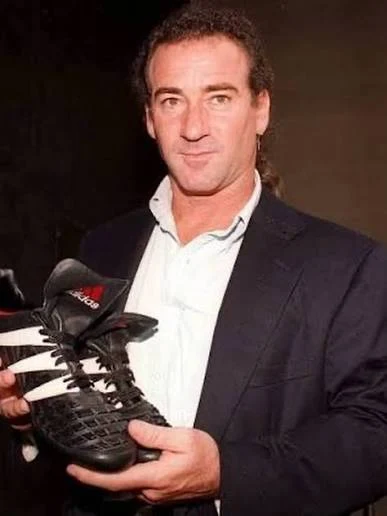 Craig Johnston with the 1994 Predator.
The Rapier followed in 1995 with the fold-over tongue. Then came the Accelerator, the Precision and the Mania. Beckham bent free kicks with it. Zidane won a World Cup in it. Gerrard, Del Piero, Raúl and a generation of others built careers in it.
More than thirty years on, the Predator is still in production, and the rubber elements Johnston cut from a table tennis bat are still its defining feature.
Why His Story Matters
It would be easy to tell the Predator story as a corporate one: a big brand, a big launch, big-name players. The truth is much stranger and much better.
The most famous football boot ever made began with a teenager nobody rated, who talked his way into English football, became a Liverpool double-winner, walked away from the game for his family, and then refused to accept that every boot company in the world knew better than he did.
Every Predator carries a piece of that story.
Frequently Asked Questions
Who invented the adidas Predator?
The Predator was based on a prototype invented by Craig Johnston, the Australian former Liverpool midfielder. adidas developed his idea and released the first Predator in 1994.
How did Craig Johnston come up with the Predator?
While coaching children in Australia, he was teaching them to swerve the ball like a table tennis player. He then fixed table tennis bat rubber to his boot, kicked a ball in the rain, and found it gave far more grip and swerve.
Did adidas turn down the Predator?
Yes. adidas initially rejected the idea, as did Nike, Puma, Reebok and Umbro. Johnston changed their minds by filming Franz Beckenbauer and other German legends testing his prototypes in the snow in Munich.
Did Craig Johnston play for Liverpool?
Yes. He played for Liverpool from 1981 to 1988, making 271 appearances and scoring 40 goals, and scored in the 1986 FA Cup final as Liverpool won the double.
Why did Craig Johnston retire?
He retired in 1988, aged 27, to care for his younger sister after she was seriously injured in an accident in Morocco.
Read more: The full Predator history · The original 1994 Predator · Predator Moments